Thursday, 21 May 2026 · Eryri, North Wales
Preamble
Not stretching in the conventional sense, not warming up for performance, but something slower and more deliberate: working the fascia, softening the tissue, trying to arrive at the walk with legs that are less guarded and more willing.
The recording I made whilst doing it turned into something I hadn't expected. I found myself thinking about the different times in my life I had needed to renegotiate my relationship with gravity — each injury, each hiatus, each return. The foot-and-mouth years. The period when I was running a multi-level marketing business and carrying bags of catalogues that hurt me more than any mountain ever had. The farm. Bristol. And before all of that, the 1999 Nepal trip, for which I had trained seriously and well.
I put on an old Helly Hansen fleece this morning — the one I wore throughout that preparation. It has the Buddha's eyes embroidered on the back. When I put it on, something happened. Not nostalgia exactly. More as though the body remembered what it was capable of, and quietly reminded me.
Then I went for a walk.
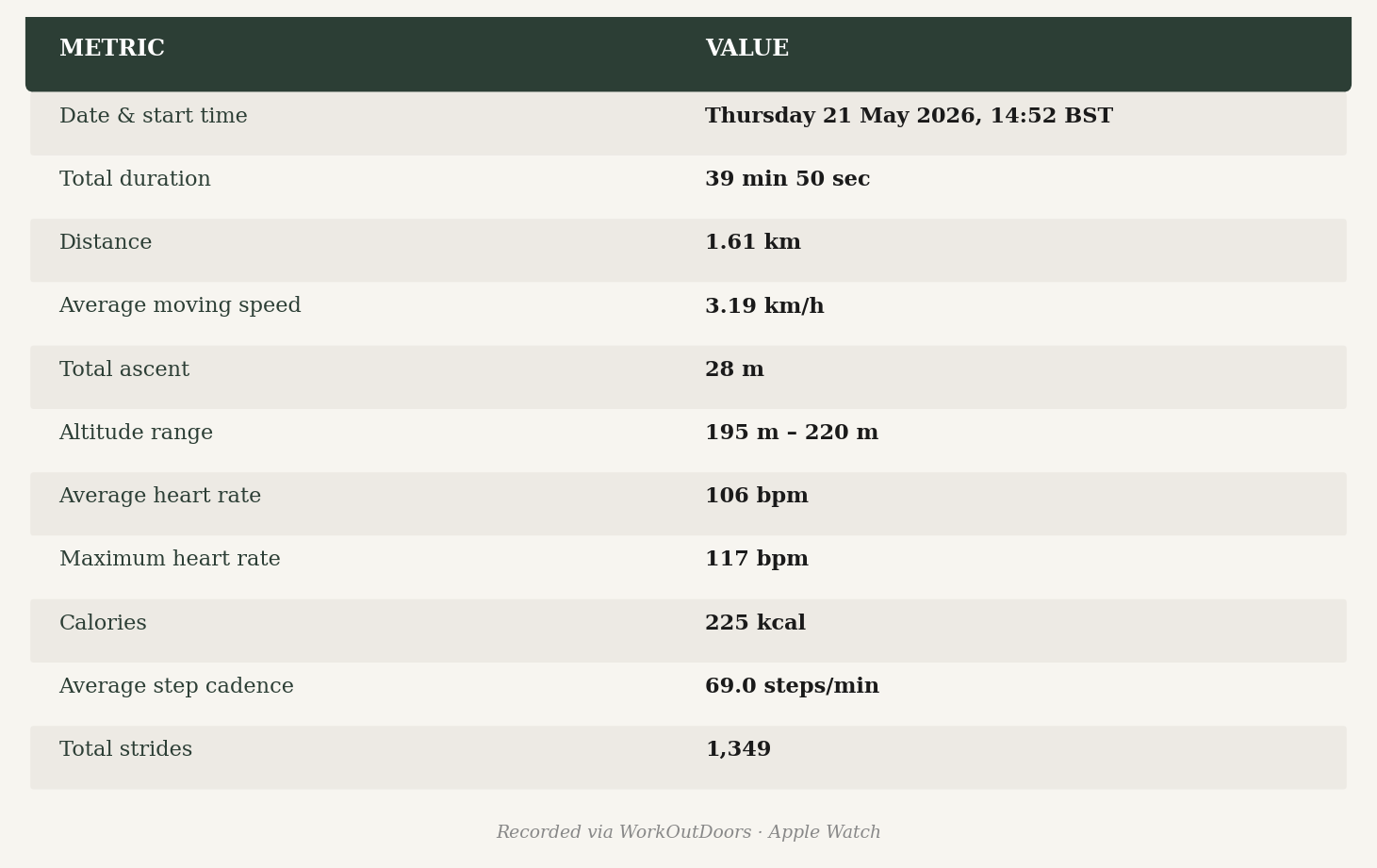
Recorded via WorkOutDoors on Apple Watch. Duration and distance reflect moving time.
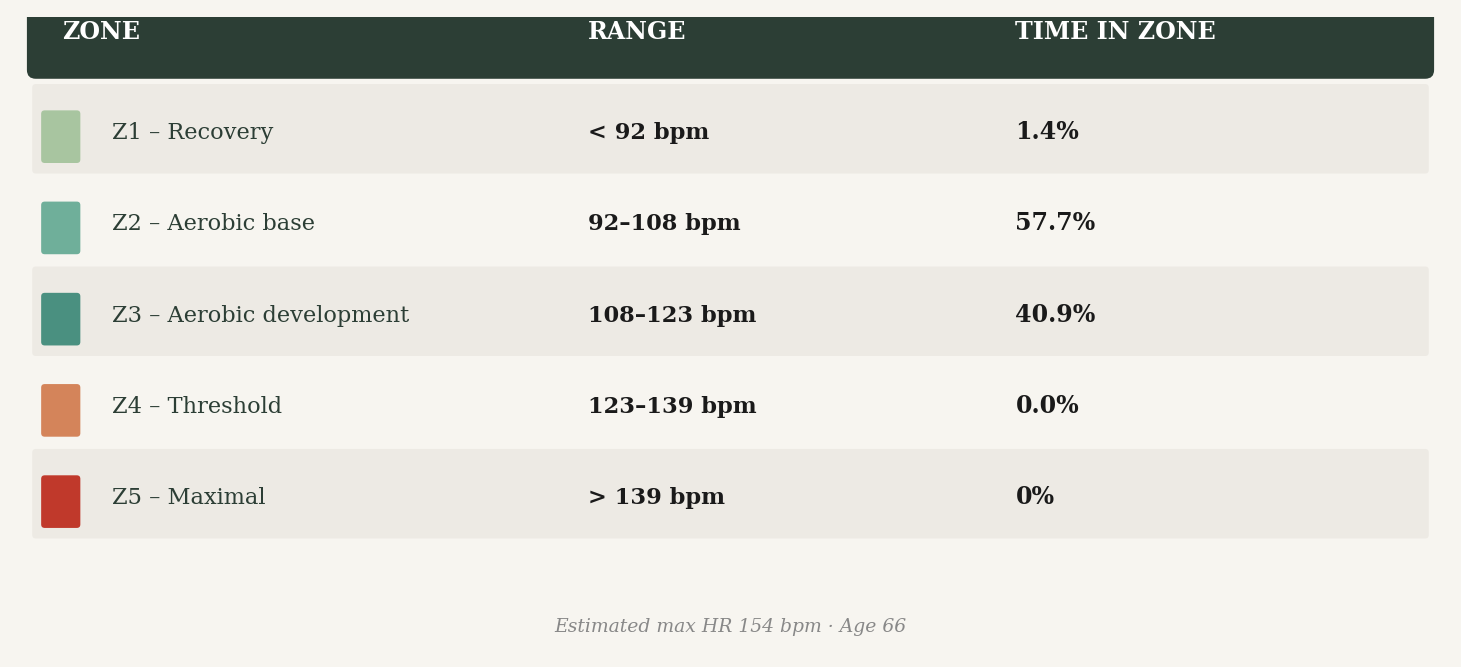
Heart rate zone distribution (estimated max HR 154 bpm for age 66)
A note on the data: the session header recorded a single anomalous reading of 160 bpm. This does not appear anywhere in the continuous record stream and is consistent with a sensor artefact — a corrupted reading rather than a true cardiac event. The working maximum for this session was 117 bpm. The 160 can be disregarded.
Explanation
A different kind of session
Tuesday's walk was a test — steep, demanding, a deliberate probe of what a month of Wuji standing had produced under load. Thursday's walk was something else. The terrain was lower, starting at 195 metres and rising only 28 metres across the route. The pace was slower. The duration was nearly twice as long.
Where Tuesday pushed me into the threshold zone for a quarter of the session, Thursday stayed entirely within Z2 and Z3. The heart rate ceiling was 117 bpm — 11 bpm lower than Tuesday's peak. That is not a lesser effort. It is a different quality of effort: sustained, contained, and — crucially — easier to recover from. I felt more comfortable after this walk than I did after Tuesday's, and the data is consistent with that.
On the fascia preparation
The pre-walk massage is beginning to feel like it matters. I am thinking of my lower limb restrictions less as muscle problems — tightness, weakness, strain — and more as fascial blockages: tissue that has been guarded for so long it has forgotten how to be otherwise. The massage protocol works from the knees down to the big toes, attempting to soften what has hardened, to restore a quality of movement that injury and compensation have gradually taken.
Whether it translates directly into the walk is difficult to isolate. What I can say is that on the easier terrain of Thursday, the legs felt less embattled than they did on Tuesday. Something may be shifting.
On memory and recovery
The pre-walk recording surprised me by becoming an inventory of recoveries. I have been through this kind of rebuilding before — several times, in different forms, after different causes. What I noticed, looking back, is that there was no single method. No programme. No system. Each time, eventually, I just did it. I got up. I kept going.
That pattern is either reassuring or meaningless, depending on how you read it. I choose to find it reassuring. Not because it promises anything, but because it suggests I have some capacity for this — and that capacity has been demonstrated, not merely hoped for.
The Nepal fleece is a reminder of that. Forty years in outdoor work has left certain objects with the texture of evidence. When the body is uncertain, the evidence helps.
On the cadence
Average step cadence dropped from 83.6 steps per minute on Tuesday to 69 steps per minute on Thursday. That is a significant reduction. On lower, more even terrain, after a fascia massage, moving at a more deliberate pace — the lower cadence reflects all of those things simultaneously. It is not deterioration. It is a different mode of moving.
There were also approximately eight minutes and forty seconds of stationary time built into the session — moments of stillness within the walk. Whether those were rest stops, observations, or simply standing in the landscape, they were part of the session. That too is not incidental.
Conclusion
Two sessions. Two different conversations with the same body on the same week.
Tuesday said: this is where the limits are. Thursday said: this is what it feels like to work within them.
The data pattern — longer duration, more distance, lower intensity, no threshold excursion, better recovery — points toward something worth repeating. The preparation mattered. The terrain choice mattered. The pace mattered.
Phase One continues. The protocol is becoming clearer: one session that probes, one session that consolidates. Fascia work before walking. Poles used lightly. Eyes up, not down. Breathwork — still to be properly begun, still the most important thing that keeps being postponed.
The lower valley will be walked again. So will the forestry road above it.
The fleece will probably come too.
All data recorded using WorkOutDoors on Apple Watch. Heart rate zone calculations based on age-adjusted estimated maximum (154 bpm). This report is a personal rehabilitation log and does not constitute medical advice.