Tuesday, 19 May 2026 · Eryri, North Wales
Preamble
The question I brought to this walk was simple: has any of that translated?
To find out I needed to put it under load.
The route is a forestry track above the valley, rising steadily through cleared pine and old mixed woodland before levelling near what I suspect is a much older line of travel — possibly Roman, certainly pre-modern. It is uneven, cambered in places, washed out in others. The kind of ground that asks something of your ankles.
I walked it with poles, a dog, and a running voice note. My Apple Watch recorded the rest.
This is Phase One. The goal is not performance. It is baseline — to know where I am starting from, so that what follows can be measured against something honest.
The Data
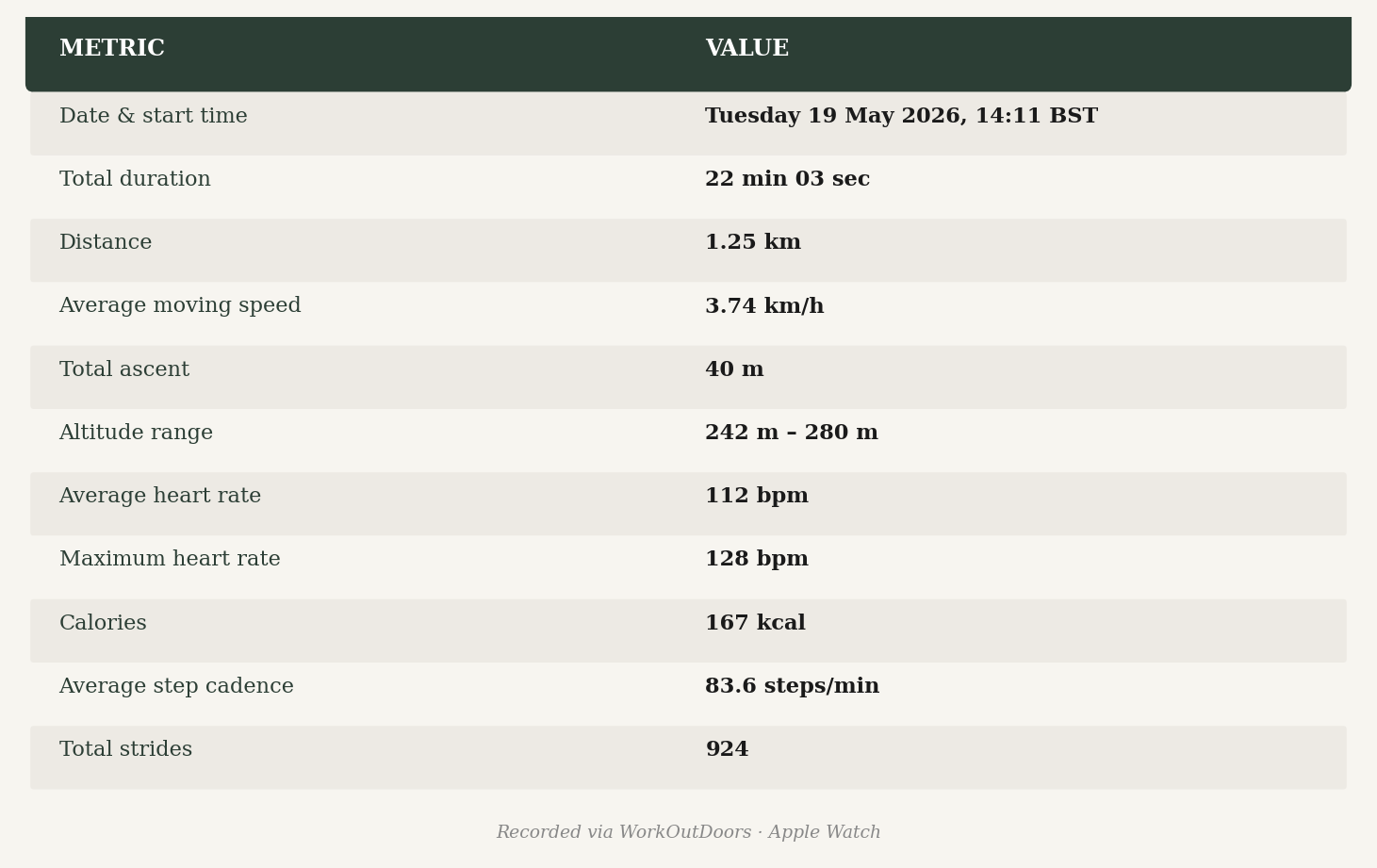
Recorded via WorkOutDoors on Apple Watch. Duration and distance reflect moving time
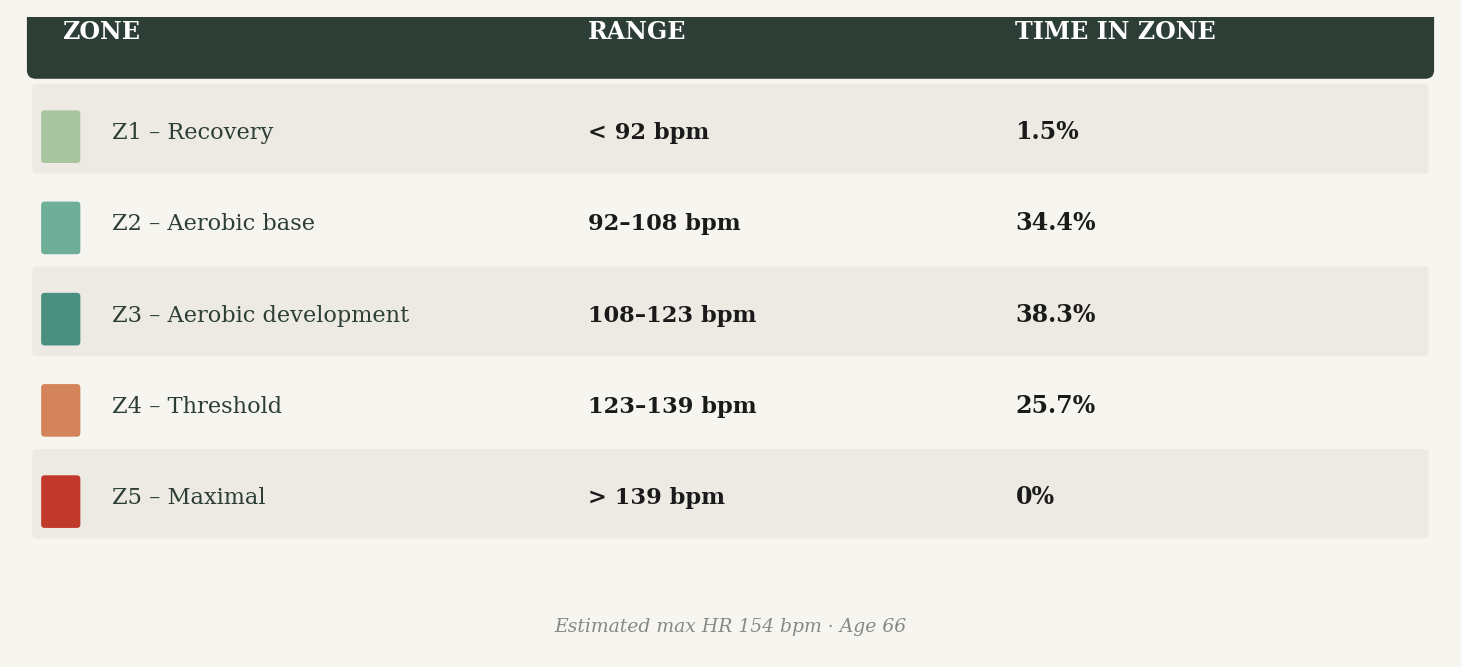
Heart rate zone distribution (estimated max HR 154 bpm for age 66)
Heart rate rose progressively through the session: average 108 bpm in the middle section, 116 bpm in the final third — consistent with the sustained ascent before the route levelled and returned.
Explanation
The numbers tell one story. The voice note tells another. Between them something closer to the truth emerges.
On heart rate and medication
To a casual observer the HR data looks controlled — bulk of the session in Z2–Z3, no excursion into maximal effort, a clean recovery on the descent. That reading is incomplete. I manage hypertension and atrial fibrillation, and the medications that do that job also blunt the cardiac response to exercise. The heart rate number understates the effort. The legs and the lungs do not.
I have come to understand this the hard way. On blood pressure medication, perceived exertion is a more reliable guide than any number on a watch face. When the thighs begin to report oxygen debt, when the breathing shifts from nose to mouth, when the body starts to feel heavier — that is the data that matters. The watch confirms; it does not lead.
There was no chest tightness. That, genuinely, is the headline.
On gait
My average cadence — 83.6 steps per minute — sits well below the 100–120 steps per minute typical of healthy walking. The gap is not laziness. It is negotiation.
The left lower limb has accumulated a set of longstanding difficulties: plantar fatigue, a history of ankle injury, and fascial restriction that I am increasingly convinced is the root cause of much of what I have attributed over the years to muscle problems. When the plantar is tired it alters foot placement. That alters ankle loading. Which alters the knee. Which loads the hip. Which drives compensatory overuse into the right leg — which is itself beginning to accumulate fatigue from years of carrying that burden.
I described it on the voice note as a limp: the right leg pushes, the left leg stumps. That is accurate. My right hip feels as though something is bunched up inside it, like a rolled towel jammed under the joint. The fascia on that side needs work.
The poles helped, and I was conscious throughout of not leaning on them — using them for rhythm and light balance rather than as a crutch. That discipline matters. The moment I lean in, my posture collapses forward, my breathing shallows, and the core engagement I have been building through Wuji dissipates entirely.
I also noticed that I watch my feet too much. The neck bows, the chest closes, the breath shortens. It is a safety response — on uncertain ground, the eyes want to see where the foot is going — but it costs more than it saves.
On cognition under load
There is something I have noticed more noticeably of late: when my legs are under significant load, my capacity for thought diminishes. Words go. The internal commentary quietens.
This is not coincidental. The cerebellum — which my 2018 stroke affected — is not solely responsible for movement. It contributes substantially to dual-task performance: the ability to walk and think simultaneously. Post-stroke, the coordination of balance and gait that once ran silently in the background becomes partly effortful and conscious. When the terrain demands more, those resources are drawn from wherever they can be found. Conversation goes quiet because the hill is borrowing what it needs.
The practical implication is that as balance improves — as the Wuji practice beds in, as the terrain work accumulates — those borrowed resources should, gradually, become available again.
On the Wuji question
Did a month of standing in Wuji translate onto moving ground?
Partially. There were moments — on the flatter sections, when the ground was even and the pace settled — where I could feel something different in the quality of my uprightness. A fraction more stillness in the trunk. A little less of the habitual forward-lean. The hips, for brief moments, felt as though they were under me rather than being dragged along behind me.
Those moments did not last. They did not need to, not yet. Phase One is about establishing that the connection exists — that stillness practice has some legibility in motion. It does. That is enough for now.
Conclusion
Twenty-two minutes. 1.25 kilometres. Forty metres of ascent. One dog. No chest tightness.
This is where I am starting from. The lower limbs are restricted, compensatory, and variable — I wake up in a different configuration of the problem each morning. The gait is asymmetric. The breathing, under load, is shallower than it once was. The cognitive load of uncertain terrain is real and measurable.
None of that is surprising. None of it is cause for alarm. It is simply the ground truth against which the coming weeks will be measured.
The protocol going forward: continued Wuji standing, progressive terrain exposure, a daily massage and mobilisation practice from knee to foot, breathwork — beginning small, before getting out of the car — and a methodical working through of Qigong movement sequences, one or two at a time, to observe what each one asks of the body and what the body is currently able to offer.
The track will be walked again. The data will accumulate. The picture will either change or it will not, and either answer is useful.
That is what a baseline is for.
All data recorded using WorkOutDoors on Apple Watch. Heart rate zone calculations based on age-adjusted estimated maximum (154 bpm). This report is a personal rehabilitation log and does not constitute medical advice.